
 Harrison Common Ground
The November 3 school levy, by the numbers
Kootenai Joint School District #274 supplemental levy. Sources are at the end.
- The annual levy amount would rise $611,618 (44.5%), from $1,373,000 a year now to $1,984,618 a year, for two years (July 2027 to June 2029), while enrollment holds flat at about 200 students.
- By tax rate, Kootenai looks lowest of the three districts on the district's handout. By dollars per student, it raises about three times as much as either one.
- Among 28 similar-size Idaho districts, Kootenai's current levy is the highest per student.
- Most of the increase goes to salaries and benefits and to special education.
- Salaries and benefits $253,275
- Special education $194,395
- Everything else $163,948
- Teachers' $5,400 stipend this year depends on the levy passing.
- Per student, classroom instruction spending is somewhat above the middle of similar districts; administration, buildings and transportation are near the top.
The ask is the largest yet: $611,618 a year more
The last five levies asked for $750,000, $750,000, $725,000, $1,373,000 and $1,373,000 a year.
Dollars a year each levy asked for. The 2026 bar is the proposal on the November 3 ballot.
Lowest rate, highest dollars per student
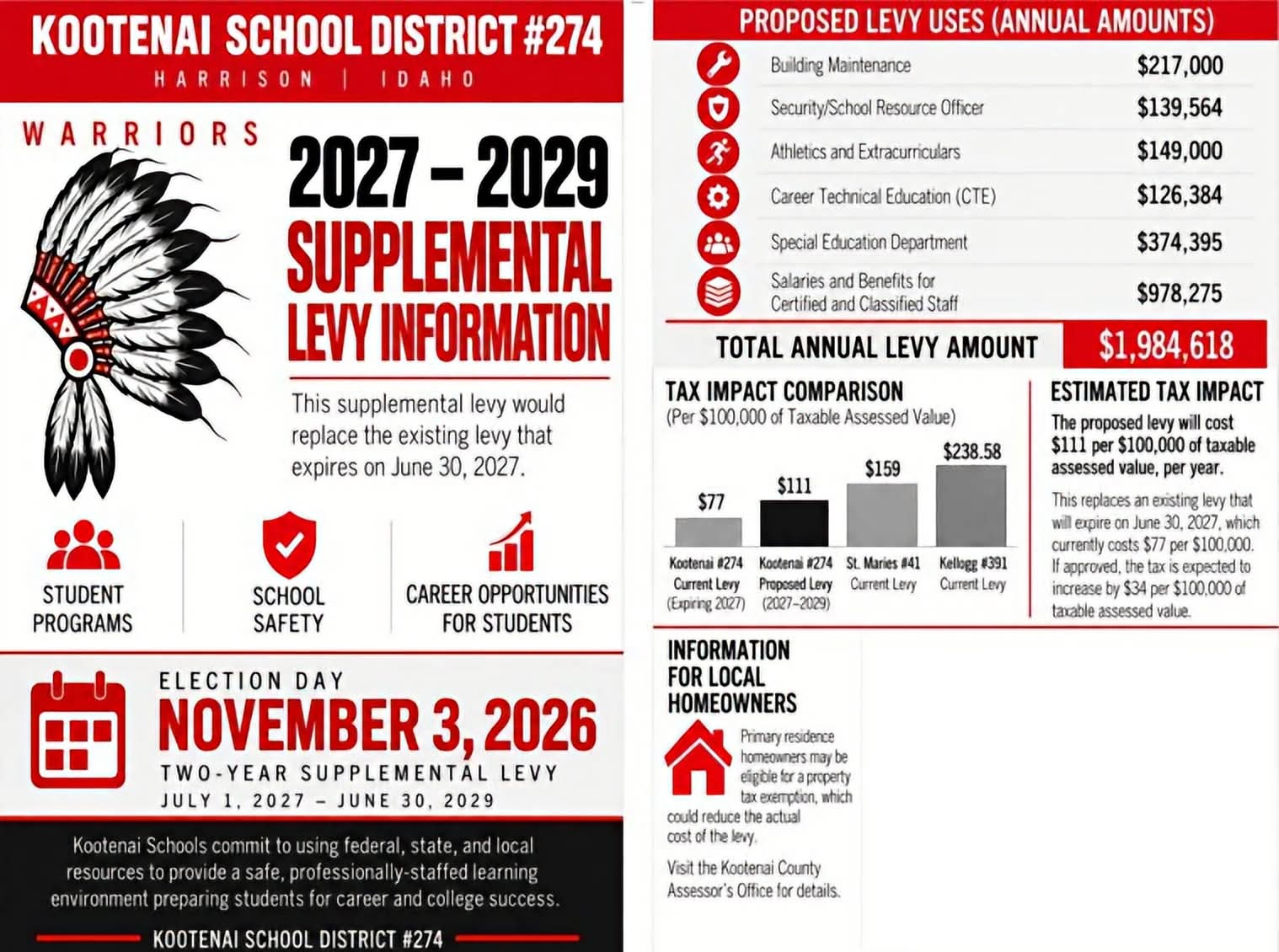
The district's handout compares tax rates with St. Maries and Kellogg. By rate, Kootenai looks lowest. By dollars per student, it raises about three times as much as either one.
Tax rate per $100,000
Levy dollars per student
Kootenai's rate looks lower because the district has a lot of taxable property for its number of students: about $1.7 billion in all, or about $8.7 million of property value for each student. That is property value, not levy money. So a lower tax rate still raises more dollars per student. Both measures are true; the handout shows only the rate.
About these figures
Tax rates are as printed on the district's handout. St. Maries' rate is for its own proposed levy on the same ballot (its current rate is $121), and Kellogg's is for the new levy it approved in May 2026; the handout labels both as current.
Dollars per student, kindergarten through 12th grade. St. Maries: its $2,488,000-a-year levy on the same November 3 ballot, 808 students. Kellogg: its $3,524,350-a-year levy approved in May 2026, 1,080 students. Kootenai: the proposal, 201 students.
Highest per student among similar districts
Among the 28 Idaho school districts closest to Kootenai's size, Kootenai's current levy is the highest per student: $6,831, against a middle of $2,143 for the other districts that have one. The proposal, $9,874, would be more than four times that middle.
No supplemental levy: Bliss, Dietrich, Midvale, Notus. Current levies are for tax year 2025, per student in kindergarten through 12th grade. The proposal would start in July 2027; the other bars are levies in place now. Each bar counts the full levy, including any part the state paid.
Enrollment has held near 200, but fewer students come from inside the district
Kootenai had 324 students in kindergarten through 12th grade in fall 1995 and a low of 137 in fall 2017. It had 206 in fall 2024, 201 in fall 2025 and 201 this fall. The share who come from other districts through open enrollment has risen every year since 2022-23, from 45 of 235 (19%) to 68 of 207 so far this year (33%). Over the same years, students from inside the district fell every year, from 190 in 2022-23 to 158 in 2025-26, while students from other districts rose from 45 to 70.
Each bar is one school year: students from inside the district, then open-enrolled students from other districts, with their count and share of the total. The district's own counts, sent in answer to a public records request on October 22, 2026.
Show the full history since 1995
Fall count, kindergarten through 12th grade, every year since 1995. Hover or tap a point for its year.
Fall count by year: 1995: 324, 1996: 312, 1997: 314, 1998: 276, 1999: 292, 2000: 296, 2001: 288, 2002: 279, 2003: 278, 2004: 268, 2005: 282, 2006: 262, 2007: 275, 2008: 275, 2009: 239, 2010: 241, 2011: 218, 2012: 218, 2013: 174, 2014: 165, 2015: 152, 2016: 145, 2017: 137, 2018: 142, 2019: 141, 2020: 151, 2021: 182, 2022: 195, 2023: 203, 2024: 206, 2025: 201, 2026: 201.
| School year | All students in the year | From inside the district | From other districts |
|---|---|---|---|
| 2019-20 | 167 | 130 | 37 (22%) |
| 2020-21 | 180 | 138 | 42 (23%) |
| 2021-22 | 200 | 159 | 41 (21%) |
| 2022-23 | 235 | 190 | 45 (19%) |
| 2023-24 | 225 | 173 | 52 (23%) |
| 2024-25 | 237 | 172 | 65 (27%) |
| 2025-26 | 228 | 158 | 70 (31%) |
| 2026-27 so far | 207 | 139 | 68 (33%) |
Fall counts: Idaho State Department of Education for fall 1995 to fall 2025; the district's enrollment report for August 24, 2026 for this fall. Year counts: the district's open enrollment counts; the district did not say whether they include preschool.
A note on these counts: they are approximate. The yearly figures from the district count every student enrolled for at least one day, so they run higher than a single fall count. This year's figure covers only part of the year. And students who are not open-enrolled are counted here as coming from inside the district.
Where the increase goes
Each levy lists the approximate amount for each use. Two uses make up most of the increase: salaries and benefits, up $253,275 a year (35%), and special education, up $194,395 a year (108%).
Increase over the 2024 levy, by use. Total increase $611,618.
Show the full table, 2023 to proposed
| Use | 2023 levy | 2024 levy (now) | Proposed | Change from now |
|---|---|---|---|---|
| Salaries and benefits | $651,000 | $725,000 | $978,275 | +$253,275 |
| Special education | $200,000 | $180,000 | $374,395 | +$194,395 |
| Building maintenance | $250,000 | $100,000 | $217,000 | +$117,000 |
| Athletics (proposed: athletics and extracurriculars) | $87,000 | $146,848 | $149,000 | +$2,152 |
| Security / school resource officer | $95,000 | $125,000 | $139,564 | +$14,564 |
| Career technical education | $90,000 | $96,152 | $126,384 | +$30,232 |
| Total | $1,373,000 | $1,373,000 | $1,984,618 | +$611,618 |
2023 and 2024: the district's levy fliers for those elections. Proposed: the resolution the board adopted on August 24, 2026, as printed on the ballot.
What the levy would pay for
At the October 26 informational meeting, the board chair's slides listed what each use of the levy would pay for. The amounts below are as shown on those slides. The district has been asked for its copy of the presentation.
Salaries and benefits, $978,275 a year
- 2 full-time teachers and 7 full-time support staff beyond what the state's funding formula covers ("above state support units"): $162,721 for the teachers and $421,879 for the support staff
- Administration: $111,886
- Local Control Funds: $94,500 for teachers and $91,889 for support staff. At the meeting these were described as money to help staff with health insurance costs, now moved into the levy. Both groups' 2026-27 pay agreements tie a $5,400 "Local Control Stipend" to this levy passing.
- A $2.00 base increase in pay for support staff, on top of that: $85,400
- Substitute teachers: $10,000
Special education, $374,395 a year
The slides put the full yearly cost at $487,223: six paraeducators ($270,575), a teacher ($81,110), speech-language services ($52,110), occupational therapy ($40,100), psychiatrist services ($37,328) and a director ($6,000). Estimated federal funds ($82,828) and state Medicaid funds ($30,000) cover $112,828 of that, leaving $374,395 for the levy.
Building maintenance, $217,000 a year
The largest items are a roof for the middle school's west gym addition ($50,000), a roof and siding patch for the bus barn ($40,000), a backup generator for the well pump ($25,000), sealing and painting the parking lots ($25,000) and service, repair and replacement of the mini-split heating and cooling units ($18,000). Eight smaller items, $5,000 to $10,000 each, cover the well and water lines, planning and testing for the wastewater lagoon, field irrigation, elementary flooring and bleachers. The slides note that, given the building's age, the facility manager expects significant unforeseen costs, such as boiler replacement or mold abatement.
Athletics and extracurriculars, $149,000 a year
The athletic director and coaches for seven sports ($71,000), transportation ($19,000), referees and officials ($15,000), a weight room update ($10,000), track and football field maintenance ($9,500), and $24,500 for equipment, high jump mats, safety gear, fees and field trips, and coaches' memberships and clinics.
Security and school resource officer, $139,564 a year
The school resource officer contract ($99,714), security camera and alarm renewal and repairs ($20,000), a wireless and server upgrade ($10,000), and $9,850 for a radio lease, door access control, and locks and safes.
Career technical education, $126,384 a year
A half-time welding teacher ($45,889), a half-time agriculture teacher ($41,495), career readiness certification ($25,000), and $14,000 for welding and agriculture supplies.
Teachers' stipend this year depends on the vote
On July 14, 2026 the board approved this year's agreement with its teachers. Above the salary schedule it says:
"Pending the November 2026 Supplemental Levy passing, the District agrees to reinstate the Local Control Stipend of $5,400/year, paid evenly December 2026 through August 2027. Additionally, the District agrees to reopen Negotiations if the November levy fails."
The teachers' salary schedule for 2026-27 is the same as 2025-26 in all 165 cells, from $51,299 to $79,994. The schedule now covers a 174-day contract, against 181 days in 2025-26. The only raise on the schedule this year is one step for another year of experience, worth $700 to $3,127 depending on the step. Teachers at the top of their column get no step, though they can still move columns for earned credits. Every step raise is smaller than the $5,400 stipend. So without the stipend, a full-time teacher earns less this year than last year with it. If the levy passes, the stipend is paid December 2026 through August 2027; if it fails, the agreement says negotiations reopen.
More on the stipend
The same night, the board also approved the classified staff salary schedule. The agenda item recommending it states the same condition: $5,400 a year per full-time employee. The minutes of the June 11, 2026 negotiations record "the discontinued Local Control Stipend beginning September 1, 2026". The stipend has been paid every year since 2022-23, each time for that school year only: $300 a month from 2022-23 through 2024-25, and $450 a month ($5,400 a year) in 2025-26.
Teacher pay against 28 similar-size districts
Kootenai's average pay per full-time teacher, as the district reports it to the state, was above the middle of the other 27 similar-size districts in 2016-17, below it from 2017-18 through 2021-22, and above it every year since 2022-23. That reported figure leaves out the stipend. Counting the stipend, Kootenai ranked 5 of 28 in 2022-23, 3 of 28 in 2023-24, 2 of 28 in 2024-25 and 2 of 28 in 2025-26.
Show the table and how it was counted
| Year | Kootenai, as reported | Rank | With the stipend | Rank | Middle of the other 27 |
|---|---|---|---|---|---|
| 2016-17 | $49,120 | 5 of 28 | no stipend | $44,229 | |
| 2017-18 | $44,683 | 23 of 28 | no stipend | $46,211 | |
| 2018-19 | $46,612 | 20 of 28 | no stipend | $47,965 | |
| 2020-21 | $45,832 | 27 of 28 | no stipend | $48,757 | |
| 2021-22 | $48,035 | 24 of 28 | no stipend | $51,185 | |
| 2022-23 | $54,246 | 10 of 28 | $57,846 | 5 of 28 | $52,498 |
| 2023-24 | $61,690 | 8 of 28 | $65,290 | 3 of 28 | $58,349 |
| 2024-25 | $65,510 | 5 of 28 | $69,110 | 2 of 28 | $61,256 |
| 2025-26 | $67,712 | 8 of 28 | $73,112 | 2 of 28 | $64,816 |
Total teacher salaries divided by full-time teachers, as each district reports them to the Idaho State Department of Education; other districts' figures include the extra pay they report. Kootenai has reported little or no extra pay for teachers in recent years, so its reported figure leaves out the stipend. "With the stipend" adds each year's stipend, assuming every full-time teacher received it for 12 months: $3,600 a year from 2022-23 through 2024-25, and $5,400 in 2025-26. The district's own payroll shows actual pay ran higher still: in 2025-26 every full-time teacher was paid at least $6,050 beyond all their contracts, mostly the stipend. 2019-20 is not included. Averages only; no one is named. For 2026-27, other districts' figures are not yet published.
Classroom spending somewhat above the middle; support services near the top
Per student, Kootenai spends $19,458 a year from its operating fund, against a middle of $14,937 for the other 27 similar-size districts. Classroom instruction is somewhat above the middle (11 of 28). Support services are near the top (2 of 28): administration, buildings and transportation all rank in the top five.
Counting all funds, not only the operating fund, Kootenai spends $23,512 per student against a middle of $21,767 (9 of 28).
Spending per student
Total spending does not count transfers to other funds. For Kootenai, instruction and support services add to the total. Administration, buildings and transportation are parts of support services. Special education is counted inside both instruction and support, so it is shown on its own and not added again. Administration covers the board, the district office, principals' offices, the business office and administrative technology. Buildings covers building care and maintenance, not security.
On the money coming in, the main difference is local property taxes: $6,277 per student, first of 28, against a middle of $1,805. State money for operations is about the same as at peers (14 of 28), and federal grants are higher (5 of 28).
Revenue per student
School year 2024-25, the latest the state has published, per student in kindergarten through 12th grade (fall 2024). Federal grants are federal money in the districts' grant funds; federal, all funds also counts school meals. Two rows are not all funds: state, operating fund, and federal grants. State, all funds includes state money in the building (capital) fund; for Kootenai that was $915,699 in 2024-25, about $4,445 per student. Without that money, Kootenai's total revenue is $24,148 per student against a middle of $22,079, still 7 of 28.
Show both tables
| Spending per student, operating fund | Kootenai | Middle of the other 27 | Rank |
|---|---|---|---|
| Instruction | $9,705 | $8,501 | 11 of 28 |
| Support services | $9,752 | $6,261 | 2 of 28 |
| Of which administration | $3,865 | $2,522 | 2 of 28 |
| Of which buildings | $2,959 | $1,719 | 3 of 28 |
| Of which transportation | $1,559 | $971 | 5 of 28 |
| Total spending | $19,458 | $14,937 | 3 of 28 |
| Special education (inside instruction and support) | $1,643 | $897 | 1 of 28 |
| Revenue per student, all funds | Kootenai | Middle of the other 27 | Rank |
|---|---|---|---|
| Local property taxes | $6,277 | $1,805 | 1 of 28 |
| Other local money | $1,843 | $2,132 | 17 of 28 |
| State, operating fund | $13,297 | $13,093 | 14 of 28 |
| State, all funds | $18,095 | $18,830 | 17 of 28 |
| Federal grants | $2,036 | $1,455 | 5 of 28 |
| Federal, all funds (includes school meals) | $2,378 | $2,120 | 9 of 28 |
| Total revenue, all funds | $28,593 | $25,963 | 7 of 28 |
The district's own flier
This is the flier the district published, the handout referred to above. It is also on the district's Facebook post of October 20, 2026 (Facebook may ask you to log in).
Show the district's flier
How these figures were counted, and sources
Show the method
Students: fall 2025 enrollment, kindergarten through 12th grade, from the Idaho State Department of Education. For Kootenai that is 201. The spending and revenue section divides by fall 2024 enrollment instead (206 for Kootenai), to match that year's money.
Current levies: the full supplemental levy for tax year 2025 from the state's levy files, counting the part the state paid through its school facilities fund, so every district is measured the same way.
Proposed levies: the amounts on each district's November 3, 2026 ballot. Kellogg: its ballot for the levy approved May 19, 2026.
The 28 similar-size districts: the 48 traditional Idaho school districts with fewer than 500 students, ranked by 2025-26 enrollment (preschool included), dropping the 10 smallest and the 10 largest, which leaves districts of 110 to 329 students. Charter schools are not included.
About the author: Tom is a former school board trustee, appointed to a vacant seat in 2021.
Show the sources
- Enrollment: Idaho State Department of Education, Historical Enrollment by District or Charter (fall 1995 to fall 2025).
- Current levies and taxable property value: Idaho State Department of Education, Tax Levies for School Purposes, fiscal year 2026 (tax year 2025).
- Kootenai's past levies: each levy's county sample ballot, cross-checked against the Department's supplemental levy history.
- Kootenai's November 3 ballot: Benewah County sample ballot; the uses match the board's resolution of August 24, 2026.
- St. Maries and the other November 3 levies: the ballot documents collected by Idaho Education News.
- Kellogg: the May 19, 2026 ballot question and results on the Idaho Secretary of State's results site (search for Kellogg).
- Rates per $100,000: the district's flier, above.
- Students from other districts: the district's open enrollment counts, sent in answer to a public records request on October 22, 2026 (not posted online).
- This fall's enrollment: the district's enrollment report for August 24, 2026, in its September 8, 2026 board packet on the district's board portal.
- Uses of the 2023 and 2024 levies: the district's levy fliers for those elections (no online copy found).
- Staff pay: the 2026-27 negotiated agreement, the classified salary schedule approved July 14, 2026, and the June 11, 2026 negotiation minutes, in the board's July 14 meeting packet on the district's board portal; earlier stipend amounts and contract days from the district's posted negotiated agreements for 2022-23 through 2025-26.
- What the levy would pay for: the board chair's slides at the October 26, 2026 informational meeting (not posted online; a copy has been requested from the district).
- Teacher pay: the Idaho State Department of Education's yearly staff salary reports, on its public school finance page.
- Spending and revenue: the Idaho State Department of Education's yearly Financial Summaries for 2024-25, on its public school finance page.
Corrections are welcome. Send a question, correction or feedback.